Showing posts with label Agricultural Development in India. Show all posts

Saturday, March 26, 2011

Inspiring Students to Think Creatively


Vijay Patil thinks out of the box. He saw an opportunity and took it. He, the principal of Saraswati Secondary School, asked SNET if he could bring his students, all 150 of them, to visit the Fire Mountain Retreat facilities and show his high school students the environmental projects that are being initiated on the premises, particularly the farming experiments. He said he would even provide lunch!

Some of the vegetables Dewa Haley has growing at Fire Mountain Retreat are from seeds he brought back from China, such as the meter long green and red beans or the tall green brocolli family member. Others are from friends'  contribution from the states, such as the heirloom seeds of Arugula and Basil. Some of the varieties he has tried are favorites for the local insects and actually never reach the mouths of humans. Others have some kind of natural inhibitants, such as Aswhaghanda, an ayurvedic plant. He also has some Brahmi growing which is known for helping the mind.  Many of the herbs are a surprise to visitors, such as the super sweet Stevia, or the hot and spicy Mustard greens, or regular parsley.


Tuesday, March 15, 2011

OUR GIVE-AWAY TREES REACHING FOR THE SKY

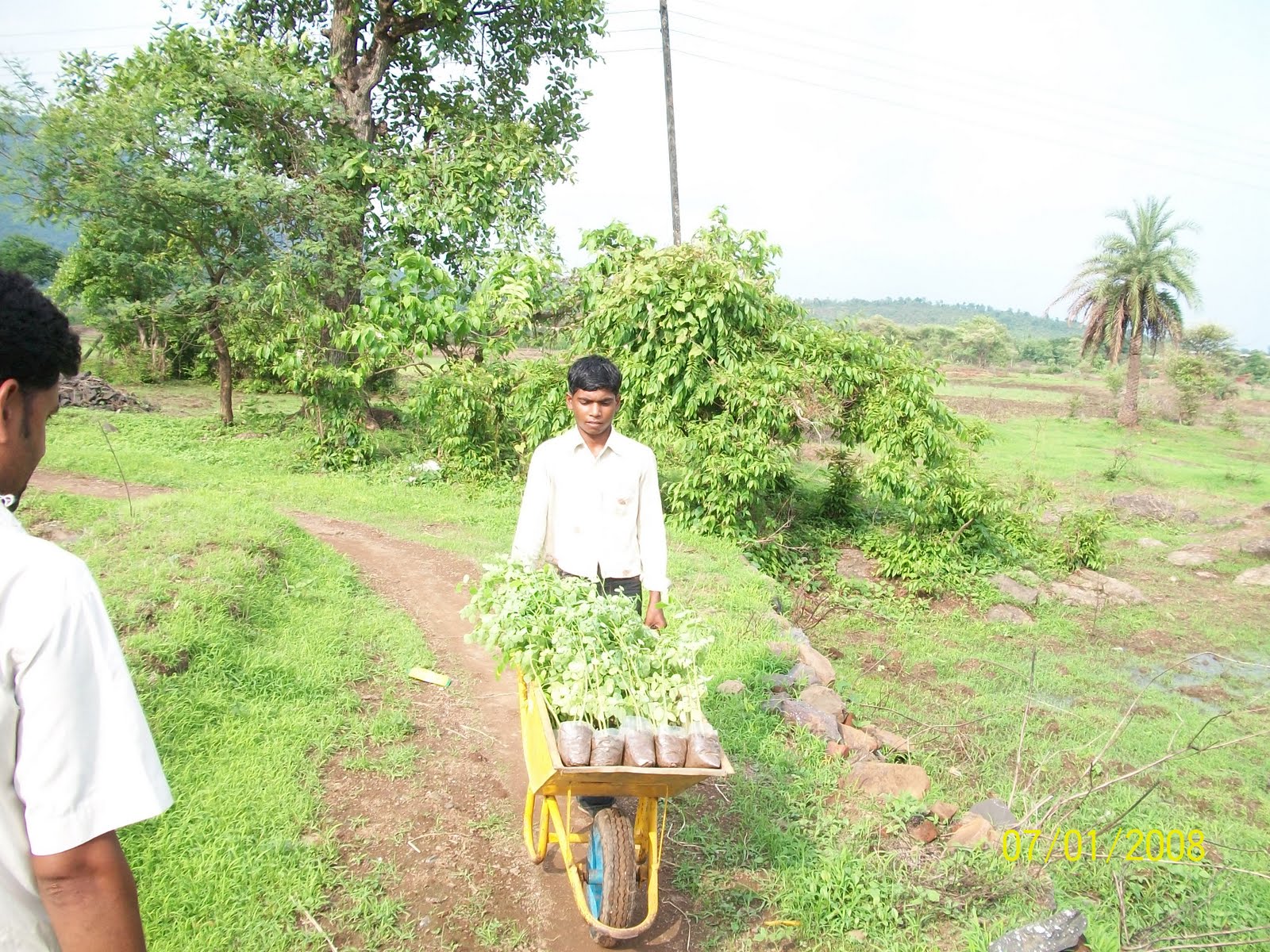
A really fun and rewarding project is the recent giving away of food-bearing trees to local villagers of the Ganeshpuri-Nimboli  Nearby Villages.  Sri Nityananda Education Trust (SNET) raised and then gave free of charge, 5000+ food bearing trees to our village neighbors. Here's a picture of trees leaving the property on the way to be planted at the homes of these villagers, and what a happy and exciting day that was to see so many people delighted to come and receive tree saplings that will give them food for years and decades to come.  Imagine how much food 5000 trees can produce!  And as we teach seed harvesting and replanting, we and the villagers gain food independence - - future food wealth.


BUT NOW IT'S BEEN 2 MONTHS SINCE THEN - - WHAT BECAME OF THE TREES?  Were the villagers successful in planting them?  Did they live through the heavy monsoon this year?  Full of curiosity, we have begun to visit village location to check on the progress on these saplings and the promise of lots of food for lots of people for lots of years.  

 What have we found? 

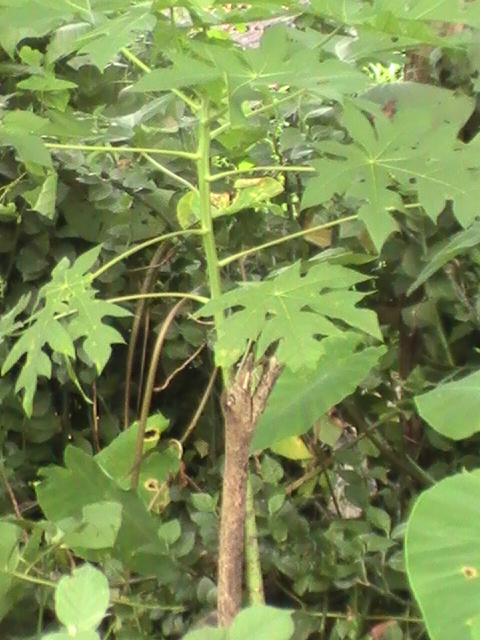
 Posted here are some pictures of the trees (papaya and drumstick) that were planted.  Some of them are surrounded by jungle vegetation as monsoon is just ending and people have not had a chance to get out and tend to them due to the heavy rains.  We, ourselves are just now whacking back the jungle weeds and recovering our gardens.  But what we found is that the trees were planted in good locations around the villagers homes and are doing quite well after only a few months in the ground. 


 This program is a bit like the wisom of "give a man a fish and he eats for a day. 
teach him how to fish and he eats for a life time."   In this case it's, "give a family a few papayas and drumsticks pods and they eat for a few days - - give them a few papaya and drumstick trees and their family their relatives, and their friends eat for decades." Wow -- what a payoff!!


We love this program.  It is a joy to see the trees growing in the villages.  These  particular trees bear mature fruit in only 6 months after planting!  They are very quick producers and were chosed largely for this reason.  Next we plan to give away tree saplings that may take longer to mature, but give food for many decades, for generations. 


We will take this program to the schools and teach the children about planting trees that give food for years with very little care on their part. FUTURE FOOD WEALTH we call it, and a wonderful gift to give another human. 
 It only costs a couple of dollars to seed and feed and care for a sapling to the give-away stage.  You might consider donating to supply food future wealth for some impoverished village people. 


 One tree can feed a lot of people - - a great investment - - a few trees can feed many families - - twenty trees can feed a village.  What a deal! and you could be the loving human who provides for them. Love matters - - a heart that feeds many people is a happy heart.  Here's how you could give from one to many trees to village people.  They are mostly wonderful people, living close to the Earth and very worthy of our assistance.  Click here to begin your happy heart gift to your new villagers or village. We will keep you posted on our blog site, and if you give for a whole village, we will keep you posted with pics about how your gift is giving.


Click here now to view the list of villages and choose your own village or click here to give as many as you like.  Future food for many is a great opportunity for us to be human.

Monday, July 26, 2010

Thousands of Fruit Trees Given Away


June 25, 2010. They came on foot with tubs on their heads, with bags in their hands, by bicycle, by ox cart, tuk-tuk, truck. The news of the plant give away had spread throught out the valley and the demand for our seedling plants exceeded our imagination. This is our first success.


We had hoped to save some of the plants for SNET to begin to create a source of income to cover manufacturing water filters, but how could we turn these people down? So more than 5000 plants went to the homes and farms of our neighbors in nearby villages.


The village of Kelthane has a very active woman’s organization and they alone took 300 plants. This is the same nearby village that asked us last year to help them build a community center which was estimated to cost about $3000 in materials. We have not been able to help. This year they asked us to help them build a residence for school children whose parents cannot afford to feed, house and send them to school but instead demand that they stay home and work in the brick making fields or farms to earn money for their own food and clothing. Obviously there is such a great need to help these people get out of poverty. How do we help them help themselves we ask?

And now here they are accepting our plants to begin to grow their own cash producing crops. This reminds me of the saying that I believe comes out of Africa. “Give a man a fish he eats for a day, Teach him how to fish, and he eats for a lifetime.” Here we are teaching our poverty level neighbors to “fish” but by growing a cash crop. This gets us of out of the loop as only a provider of cash but gives a means by which the villagers can begin to take care of themselves.


SNET is working to help our neighbors get on this ladder out of impoverishment. We need your help.
Please give.  http://www.shreenityanandaeducationtrust.org/.


Sunday, July 25, 2010

The Plant Give Away Project Has Begun


Now what to do with all these seeds? Fortunately, SNET has MotiRam supervising the landscaping and gardening for Fire Mountain Retreat Center who has many years experience of agriculture and farming in the Tansa Valley.


Based on Dr. Bhore’s suggestions, we bought 5000+ plastic bags, soil, and organic matter which we had our staff fill all of these bags for seeds. For over four weeks, our staff filled and planted these precious seeds.
Ananda and Shuresh filling the 5000+ plastic bags.


Once the seedlings started popping up out of the soil, we started feeling protective of them. An occasional cow was still finding away into our compound through our plastic fence. Last year we had cows coming into the compound on an almost daily basis. We knew we had to do something to keep them out this year but we didn’t really have a budget for building a fence out of stone or brick. So we tried something new: we bought enough shade netting to cover the entire boundary. And it worked: only two or three cows figured out that they could break their way through the thin veil of plastic.


The drumstick plants shot out of the ground quickly and strongly but the papaya were very slow to emerge. We were a little concerned that we might lose all those papaya seeds. We were aiming for a mid-June plant give-away and had begun to tell our neighbors to get their holes ready to receive the plants. We certainly wanted to have viable seedlings available for the give away.


Friday, July 23, 2010

Creating Enthusiasm for a New Future in Farming

Dr. Nitin Bhore's enthusiasm for creating a new future through agriculture and organic farming has inspired the staff and volunteers of SNET. He is somewhat of a pied-piper with everyone excitedly listening to his message of hope. He suggested that SNET grow saplings of fruit trees and create a give away program for our neighboring farmers and villagers who struggle so hard to create any kind of profit or value for themselves and their families. (Please read the previous blog entry, June 8, 2010). His advice included not only giving away plants, but also providing instruction on how to prepare the soil by digging big enough holes for the plants to grow into, utilizing organic fertilizers of local cow and sheep dung or manure, and providing water to the trees by recycling household water. The villagers with no land of their own were told to dig holes around their homes so that they could monitor the care and watering of their trees as well as protect the harvest from scavengers.


So on April 23, 2010 Sunil Anaokar, Pervez Kazi, MotiRam, Dewa and Jeanetta Haley traveled to Pune for the day to meet Dr. Bhore in his home town and "go shopping," but not for mere household items or clothes, but for seeds. Dr. Bhore offered to take them around Pune and find the best papaya and drumstick seeds.
He graciously took us into his home in Pune which vibrates with love from the hearts of entire family: himself, his wife, his mother, and two boys. The home reminds me of a Mexican country farmhouse, hand carved doors and furniture. In fact, Dr. Bhore is of Mexican descent but I don’t think he has ever visited Mexico. But it is obviously in his blood, for he is immensely creative with the construction materials available in India. His mother served us homemade “starters” which might be called “tapas” if we were in Mexico. Little pie shaped dumplings.
Before shopping he took us to a Blue Nile for lunch of “the best Briyani in Pune” and it was good. Because of the increased threat of terrorism in Pune there was a metal detector and security at the door like there is airport and cameras on the walls. The world is a different place even in Pune, where there was a bombing of a German Bakery in the past few months. In contrast, on the walls were these cute photos of animals, from a more innocent era. One had a quirky photo of a lamb with the caption, “Pleased to meet you, Meat to please you.” Guess I am kind of quirky to remember it.

Afterwards we bought our papaya seeds, drumstick seeds, marigold seeds and a few vegetable varieties we hadn’t seen before. Dr. Bhore recommended various other supplies he thought would help us in our agriculture venture. We were thrilled to have his expertise and connections for getting seeds. At one seed shop, he actually opened up the seed package to see if it contained good seeds. Now, we would not have thought to do that. And what he discovered was poor quality dried-up seeds. Needless to say, we did not buy those. Thanks Dr. Bhore.

At the Pune Agriculture Marketing Center seen to the left, we were approached by a man from northern India selling his last bags of Basmati rice out of the back of his little motorcycle type truck. Dr. Bhore asked to see the rice. He took it into his hand, examined it, and then smelled the rice, just like he might do if it was wine. He thought it was good. When we each took a little into our hands, we understood what he meant. What an education to be with someone who knows the field of agriculture. Four of us bought the man out of his last bags for a very good price.


After the shopping adventure, we made a short trip to visit Hazrat Babajan again for Kazi and MotiRam to experience. This evening was a special day at the shrine and it was not open for visitors as in the past visit. But we were allowed to take her darshan through the windows. Kazi put on his white little cap that is part of his Muslim culture, which proved to be his entry ticket. The person at the door could see his earnest and he was lucky enough to be allowed inside for the first time. You can see him peering into the window to the right. What bliss for all of us to visit her again.

Dr. Bhore had us return to his home where he entertained us in his garden patio in the front of his yard that is magically lit by twinkly lights and surrounded by tall bamboo and flowering hibiscus. He described to us how many people walking by his home will stop and ask if this is some kind of restaurant. He brought out a very good red wine for us to try which we rarely see living in Nimboli. One of his contacts, who has become a friend, like us, makes wine. It was a nice touch after a long day. Fortunately when you hire a car, you already have a designated driver and we were escorted home.


Tuesday, July 20, 2010

SNET Explores the Challenges of Indian Farming

Jan. 2010. Shree Nityananda Education Trust (SNET) staff member, Sunil Anaokar suggested that SNET should consider attending an agriculture exposition in Pune, Maharashtra to see what could be learned about benefitting the local farmers in India in their plight of trying to make create a livelihood through farming. So we, Sunil, Dewa and Jeanetta Haley, traveled the three hours to Pune to immerse ourselves in learning about the most modern farming practices in Maharashtra State.

We arrived early enough to search out one of our favorite saint’s samadhi shrines, that of Hazrat Babajan. She was born into a royal Muslim family of Pakastan, but being a realized being, she had little use for material life, and spent most of her later years on the side of a busy street in Pune. People of all faiths would come visit her there for her darshan and blessings and continue to do so even now at her tomb. She was the one who first assisted Meher Baba in awakening to his life as an Avatar with a kiss on the forehead. (See this website for more information http://mehermelb.jimdo.com/perfect-masters/babajan). The three of us have a personal devotion to her and wished to have her darshan before we began our exploration of the world of agriculture. We hired a tuk-tuk (auto-rickshaw or motorcycle type taxi) to show our driver the way through the winding streets of Pune. Kudos to Sunil who thought of this successful tactic. It was a quiet day at her shrine and we were allowed to soak in her grace and blessings with little distraction. As two westerners and Dewa being over six feet tall as well, we always get many stares and many hands reaching out for a few rupees, but once those who revere Hazrat Babajan see that we are there in devotion and not just sight-seers, we are given room to bask in her love and bliss which is so present there at her shine.

Filled with this special blessing, we moved on to the exposition. We met many people and located many possibly valuable farming venders, but the one that literally jumped out in the aisles to greet us was Dr. Nitin Bhore. His 12’ X 12’ booth was lined with big green billboards and photos describing the various successful roles he plays in the world of agriculture, and peopled with many young students who were very inspired and devoted to his thoughts and ideas about agriculture and organic farming. He has a big presence! We told Dr. Bhore of the charity SNET and its desire to help improve the conditions for the local farmers and he agreed to help. We were so excited to enlist his help but little did we realize that our meeting was the beginning of a new and deep friendship as well as a very significant flow of grace and benefit to our neighborhood farmers and villagers.

Dr. Bhore thinks of farming as an investment and teaches farmers to begin thinking about the entire financial picture of what they are farming. Twice in the early spring, he visited SNET’s headquarters at the Fire Mountain Retreat Center (www.firemountainretreat.org) to begin his instruction to the staff and volunteers of SNET about “smart farming” practices. Dr. Bhore advises that a farmer would be wise to plant crops for cash profit in about six months, such as papaya or drumstick, marigolds, ayurvedic herbs, or other plants that there is a high demand for but little availability. With Mumbai only 2 ½ hours away, many big hotels are clamouring for organic vegetables. Most farmers grow the same things that their neighbors are growing, such as tomatoes, or cabbage and hence there is lots of competition for the same ten and twenty rupee note. But after the first successful crop helps put food on the table and some money in the farmer’s pocket, he should begin to think about growing fruit trees that will provide fruit in about five or six years. This is a photo of a four month old papaya tree. As you can see, they grow very fast, providing fruit by the sixth or eighth month.


At one of the early "smart farming" lectures, our neighbors listen with great earnest and enthusiasm to what Dr. Bhore advises.


We read of an Indian man in the state of Bihar who planted mango trees when his daughter was born. It has become a practice in his area to abort or kill female children due to extreme poverty. Why? Because young females grow into adult women who need a dowry and marriage. If the father has no idea of how he will feed his children now, and much less provide a dowry in the future, this seems like a plausible solution. But instead this man planted mango trees. When she reached the marriage age he had already been saving over $ 4000 US per year for three years and had the necessary money for the marriage. (see link: http://www.bbc.co.uk/news/10204759).

Tuesday, June 8, 2010

Local Farmers Currently Have No Hope of Realizing a Profit from their Farming, Just Two Hours North of the Financial Capital of Mumbai


In the opening speech to the Shree Nityananda Education Trust's SMART FARMING SEMINAR, Chandrakant Bhoir summarized the plight of local farmers. As a full time agriculturist/farmer and involved in social services of the Wada Taluka within the District Thane of Maharashtra, India, Mr. Bhoir is able to "tell it like it is." He is chairman of the board for various educational institutes, specifically the Vajreshwari Marathi High Secondary Studies. He is personally interested in the changing of the farming situation for all farmers. His father, Bongo Nana Bhoir, was member of Parliament, known for his work for society and village, and a founding member of Shree Nityananda Education Trust.


We are happy to present Mr. Chandrakant Bhoir ideas here. (His original speech was in the state language of Marathi and translated into English):

“As we look at our current scenario of farming, we see farmers who have no hopes of realizing farming as a productive business. Behind the debacle of the farming situation some government officials and some leaders and politicians are responsible. They have not taken any positive steps, actions or solutions to attend to farmers’ grievances.

Special guest Dr. Nitin Bhore, who did his PhD research in agriculture, has been invited by SNET to look into the matter and guide the farmers toward prosperous farming. Dr. Bhore knows how to guide farmers to switch their current condition to profit making farming. Right now thousands of farmers are committing suicide due to failure in crops, no productivity of farming, microloans at high interest rates, and inability to provide for families. Dr Bhore has knowledge of techniques to save farmers and he will give us his valuable guidance.

Before commencing his valuable lecture, I would like to disclose to him the actual problems of farmers. Here in our own area, rice farming is the most important crop between monsoons. Our normal farmer is used to applying chemical fertilizers to cultivate his land and has been relying heavily on them. Powder urea fertilizers are easily available but due to lack of knowledge and guidance, farmers are heavily using urea. As a result, farms, soil and productivity are dying like a slow poison. Urea is actually killing the soil.

Government schemes are just on paper and have little implementation. Currently, in Thane, a farming guidance program is taking place, but in our area no such programs have been organized. SNET has recognized this issue and has organized this valuable program for the sake of our farmers. In other areas of Western Maharashtra, many agriculture committees have been formed, from the village level up to the district level, which are functioning well and working towards solving the problems of farmers, from field cultivation all the way to marketing and selling.

It is a very good thing that for the last 8 to 10 years, farmers are growing many kinds of crops and diversifying to include vegetable farming. During months like December, January, February and March they are producing vegetables. Unfortunately they are getting low prices for these goods. In Thane, vegetables are 40 rupees per kg but the local farmers are unable to get even 20 rupees per kg.

Mostly commission agents and middlemen are getting the advantage of these prices. They come to the farmers and purchase goods at very low prices and sell them to the main market at much higher prices. The Agriculture Product Marketing Complex(APMC)at Vashi (New Mumbai) and other APMCs are controlled by a few big personalities and politicians. They switch the price up and down whenever they want. Farmers avoid going to the APMC because transporting costs, warehousing or storage costs, carriage, commission agent fees and other miscellaneous costs are so high. The Vashi APMC is the closest marketing complex to us and is more than 75 kilometers. away. There is no arrangement of such a market nearby which can give a good and fair price to the farmers.

All political parties and politicians are one and the same. The people who we have elected at the various levels of government are not raising a single issue about the farmers’ problems. There is no one to represent the farmers’ issues at the top level. For raising all these problems, the elected person must be a farmer and loyal to farming.

Whenever there are failures in crops, there are no refunds. The insurance of crops is calculated on 3 years aggregate loss. If it is less than 50%, then farmers get very little compensation after spending many hours of applying for assistance.

In short, there is no fair price for agriculture products. No awareness of water management such as sprinklers, dripping systems, etc. No marketing complex nearby. No knowledgeable assistance. No innovative steps from local government.

I give thanks to SNET for allowing me to make this opening speech. Thank you everybody.”

Wednesday, May 12, 2010

Agricultural Project Kickoff

INDIA IS BIG LOVE. Big as the sky and deep as the ocean and as long as eternity. And She is growing and prospering nicely. And She wants to take all her peoples with her on this wonderful new expansion of wealth and prosperity. And some of her people need some help. They don’t have the means and the knowledge to join in on this new wave, yet they are the very ones that have built the structures of the New India brick by brick, day by day, for not enough to feed the families and have clean drinking water.


Farmers signing into event featuring Dr. Nitin Bhore. He spoke about how to grow profitable crops.


Farmers listening intently to Dr. Nitin Bhore.


Group shot of all the farmers attending Dr. Nitin Bhore's talk.


"When you are inspired by some great purpose, some extraordinary project, all your thoughts break their bounds. Your mind transcends limitations, your consciousness expands in every direction, and you find yourself in a new, great and wonderful world. Dormant forces, faculties and talents come alive, and you discover yourself to be the greater person by far than you ever dreamt yourself fo be." Patanjali


Won't you join Shree Nityananda Education Trust in this greater purpose?


http://www.shreenityanandaeducationtrust.org/


OneTrueFan